
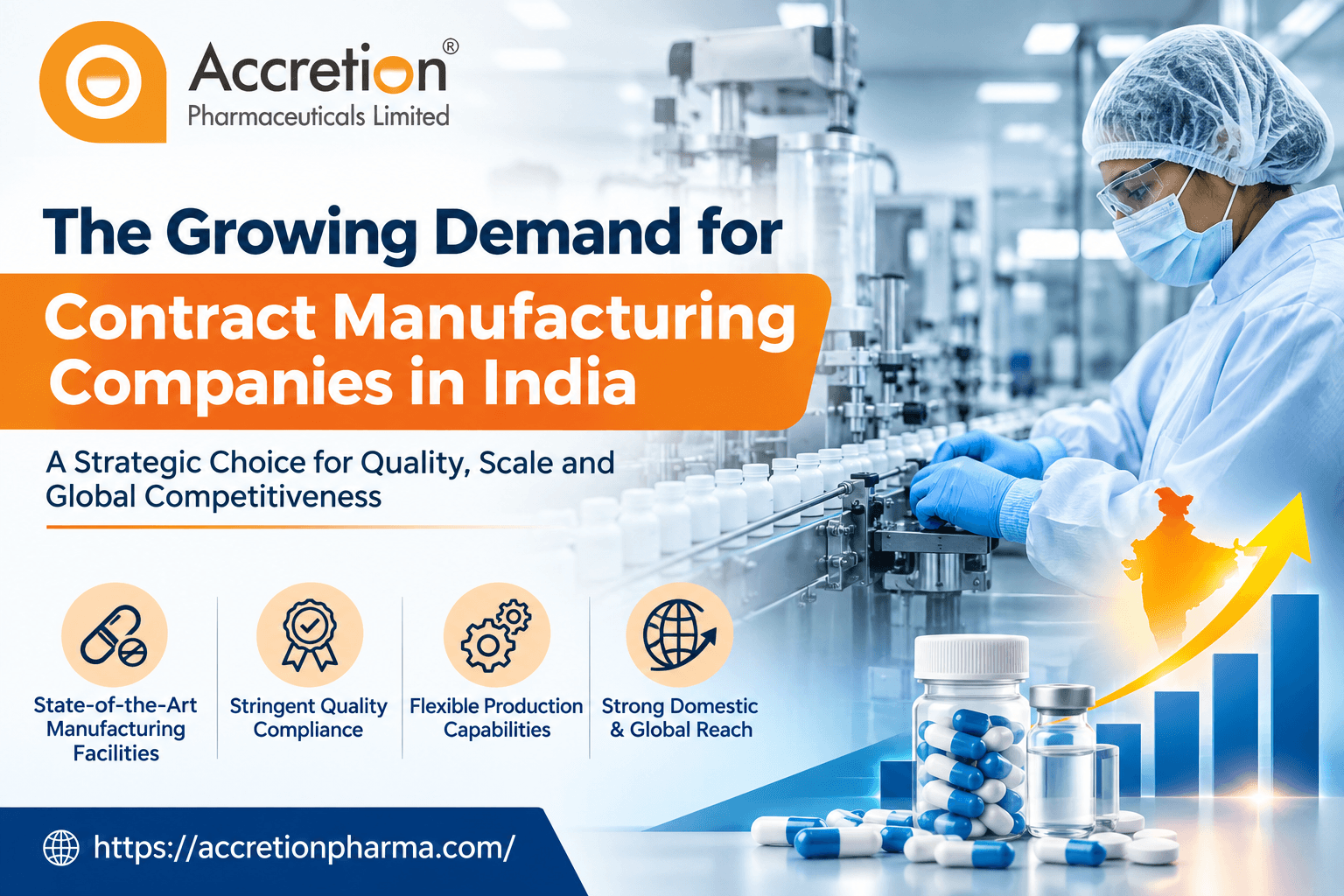
India’s pharmaceutical and healthcare manufacturing ecosystem is becoming increasingly attractive to businesses that want to develop, produce, and scale products without building their own manufacturing infrastructure. Rising domestic demand, export opportunities, regulatory capabilities, and the availability of specialized facilities are contributing to this shift. A Contract Manufacturing company can help businesses access established production capabilities while allowing them to concentrate on product development, branding, distribution, and market expansion.
The demand for contract manufacturing in India is growing because businesses can access established facilities, technical expertise, quality systems, and production capacity without investing heavily in their own plants. India’s strong pharmaceutical ecosystem, skilled workforce, expanding domestic market, and export capabilities further support the model.
What Is Contract Manufacturing?
Contract manufacturing is a business arrangement in which one company hires another specialized manufacturer to produce products according to agreed specifications, quality requirements, and commercial terms.
In pharmaceuticals, the arrangement can cover activities such as formulation manufacturing, processing, packaging, testing, and related production operations, depending on the agreement and applicable approvals.
The model is particularly useful for companies that have a product concept, brand, distribution network, or market opportunity but do not want to establish a complete manufacturing facility.
India is already a major pharmaceutical manufacturing hub. Industry data indicates that the country is the world’s third-largest pharmaceutical producer by volume, with a large manufacturing base supporting generics, APIs, vaccines, biosimilars, biologics, and contract research and manufacturing.
Why Is Contract Manufacturing Growing in India?
Several structural factors are supporting demand.
1. Lower Infrastructure Requirements
Building a pharmaceutical manufacturing facility requires substantial investment in land, utilities, equipment, validation, quality systems, personnel, and regulatory compliance.
Working with an established manufacturer can reduce the need for a business to create all of this infrastructure independently.
This does not eliminate costs or regulatory responsibilities, but it can change the economics of entering or expanding within a product category.
2. Access to Specialized Expertise
Modern pharmaceutical production requires more than machinery. Manufacturers need trained technical teams, quality-control systems, documented processes, testing capabilities, and regulatory knowledge.
An experienced manufacturing partner may already have these capabilities in place, allowing a product owner to focus more heavily on commercial activities.
3. Growing Domestic Pharmaceutical Demand
India’s pharmaceutical market continues to expand across therapeutic categories and healthcare segments. IBEF reports that the Indian pharmaceutical market was estimated at approximately US$60.32 billion in 2026 and is expected to grow further through 2031.
This expanding market creates opportunities for businesses looking to introduce new formulations, strengthen existing portfolios, or enter specialized healthcare segments.
5. Strong Export Ecosyste
India’s manufacturing advantage extends beyond the domestic market. Pharmaceutical exports surpassed US$31 billion in FY2026, despite international pricing pressures, regulatory challenges, and geopolitical uncertainties.
For companies targeting international markets, an appropriately qualified manufacturing partner can provide access to production capabilities that may support broader regulatory and export requirements.
What Makes India Attractive for Pharmaceutical Manufacturing?
India combines manufacturing scale with a broad pharmaceutical knowledge base.
The ecosystem includes pharmaceutical companies, API producers, formulation manufacturers, testing laboratories, packaging suppliers, logistics providers, research organizations, and regulatory professionals.
Government initiatives have also supported domestic manufacturing. The Production Linked Incentive programme, for example, was introduced to encourage pharmaceutical manufacturing investment and product diversification.
However, cost alone should not determine the choice of a manufacturing partner. Quality systems, technical capability, regulatory compliance, consistency, documentation, and supply reliability are equally important.
When Does Private Labelling in India Make Sense?
Private labelling allows a business to market products under its own brand while production is handled by another manufacturer, subject to the applicable legal and regulatory framework.
Private Labelling in India can be attractive for businesses that already have distribution channels or strong market knowledge but do not operate their own production facilities.
Before entering such an arrangement, businesses should understand exactly which party is responsible for product approvals, specifications, quality release, packaging information, complaints, recalls, and other regulatory obligations.
How Should Businesses Evaluate a Contract Manufacturer?
Selecting a manufacturing partner should be treated as a due-diligence exercise rather than simply a price comparison.
1 Review manufacturing capabilities: Confirm that the facility can manufacture the required dosage form, product category, batch size, and packaging configuration.
2. Assess quality systems: Examine quality-control procedures, documentation practices, testing infrastructure, deviation handling, and change-control systems.
3. Verify regulatory status: Confirm relevant licences, approvals, registrations, and applicable manufacturing standards.
4. Evaluate production capacity: Determine whether the facility can support both initial requirements and future volume increases.
5. Review commercial terms: Examine minimum order quantities, lead times, payment terms, tooling or development costs, and pricing mechanisms.
A site audit can provide additional confidence because documentation alone may not reveal how consistently procedures are implemented.
Contract Manufacturing Company vs. Building Your Own Facility
| Factor | Outsourced Manufacturing | Own Manufacturing Facility |
| Initial infrastructure investment | Generally lower | Generally high |
| Manufacturing control | Contract-dependent | Direct |
| Technical resources | Access through partner | Must be developed internally |
| Production scalability | Depends on partner capacity | Depends on owned capacity |
| Regulatory responsibility | Shared according to arrangement and law | Primarily internal |
| Time to production | Potentially faster | Usually longer |
| Long-term capital commitment | Lower | Higher |
The better option depends on the company’s product portfolio, expected volumes, capital position, regulatory strategy, and long-term objectives.
What Is Driving Demand for Contract Manufacturing Services in Ahmedabad?
Ahmedabad and the wider Gujarat region have an established pharmaceutical and chemical manufacturing ecosystem. This makes the area relevant for businesses evaluating production partners, particularly when supplier networks, technical talent, logistics, and industrial infrastructure are important considerations.
Contract Manufacturing Services in Ahmedabad can be relevant to companies seeking access to established manufacturing capabilities without immediately investing in a dedicated production facility.
However, location should not be the only selection criterion. A manufacturer with the right quality systems and technical capabilities may be more suitable than a geographically closer facility that cannot meet the product’s requirements.
Which Regulatory Factors Should Businesses Check?
Pharmaceutical manufacturing in India operates within a regulated framework involving both central and state authorities. The Central Drugs Standard Control Organisation (CDSCO) is India’s national regulatory authority, while state authorities have important responsibilities relating to drug manufacture, sale, and distribution.
The Drugs and Cosmetics Act, 1940 and associated rules form an important part of the regulatory framework.
Businesses should also consider applicable manufacturing standards, product permissions, documentation requirements, testing obligations, labelling rules, pharmacovigilance responsibilities, and export-market requirements where relevant.
Regulations can change. CDSCO continues to issue updated circulars and guidance, including recent material relating to pharmacovigilance and manufacturing compliance.
For this reason, companies should verify current requirements with qualified regulatory professionals before commercial production.
What Are the Biggest Risks?
Contract manufacturing can provide flexibility, but it also creates dependencies.
Common risks include:
- Inconsistent product quality or documentation.
- Production delays caused by capacity constraints.
- Unexpected changes in raw-material availability or pricing.
- Insufficient transparency around quality investigations.
- Unclear ownership of specifications, formulations, intellectual property, or technical documents.
- Weak contractual arrangements covering recalls, deviations, confidentiality, and liability.
A strong quality agreement and clearly written commercial contract can help define responsibilities before manufacturing begins.
Expert Due-Diligence Checklist
Before finalizing a manufacturing relationship, businesses should examine:
- Current manufacturing licences and relevant regulatory approvals.
- Quality-management and testing procedures.
- Facility capacity, equipment, and maintenance practices.
- Batch records, specifications, certificates of analysis, and traceability systems.
- Supplier qualification and raw-material controls.
- Stability-testing and product-development capabilities where applicable.
- Complaint handling, deviation management, CAPA, and recall procedures.
- Business continuity and contingency planning.
- Confidentiality, intellectual-property ownership, and data protection provisions.
- Pricing, minimum order quantities, lead times, and termination clauses.
The objective is not simply to find the lowest manufacturing quotation. It is to identify a partner capable of delivering consistent quality and reliable supply over the intended commercial lifecycle.
Why Will Demand Continue to Grow?
The underlying business case is broader than manufacturing cost.
India’s pharmaceutical sector is moving toward more sophisticated capabilities, including complex formulations, biosimilars, vaccines, APIs, and other advanced manufacturing activities.
At the same time, businesses increasingly need flexibility. Product demand can change quickly, new brands can emerge, and companies may want to test a market before committing substantial capital to permanent infrastructure.
Contract manufacturing can therefore function as a strategic operating model rather than simply an outsourcing arrangement.
Key Takeaways
1.Contract manufacturing can reduce the infrastructure burden associated with establishing production capabilities.
2. India’s pharmaceutical ecosystem provides substantial manufacturing, technical, and export capabilities.
3.Quality systems and regulatory compliance should carry as much weight as commercial pricing.
4.Private-label businesses should clearly define manufacturing and regulatory responsibilities before launch.
5. Ahmedabad and Gujarat can be relevant manufacturing locations because of their established industrial and pharmaceutical ecosystem.
6.Due diligence, quality agreements, contracts, and supplier audits are essential for reducing operational risk.
Conclusion
The growing demand for contract manufacturing in India reflects a wider shift toward flexible, specialized, and scalable production models. India’s established pharmaceutical ecosystem, expanding domestic market, export strength, skilled workforce, and continuing investment in manufacturing provide a strong foundation for this model.
For businesses, the key is to look beyond manufacturing price. A reliable Contract Manufacturing company should be evaluated through quality systems, regulatory compliance, technical capability, capacity, documentation, supply reliability, and transparent contractual responsibilities.
Companies researching top manufacturing companies in ahmedabad should therefore compare capabilities and compliance rather than relying only on reputation or location. For additional information about pharmaceutical manufacturing and related industry capabilities, readers can also explore Accretion Pharma and its available manufacturing resources.
Faqs
What is contract manufacturing in the pharmaceutical industry?
Contract manufacturing is an arrangement in which a pharmaceutical business engages another qualified manufacturer to produce products according to defined specifications and contractual requirements. Depending on the arrangement, services can include manufacturing, processing, packaging, testing, and related production activities. Regulatory responsibilities remain dependent on the product, licences, approvals, and roles assigned under applicable Indian regulations.
Why is India becoming popular for contract manufacturing?
India has a large pharmaceutical manufacturing ecosystem, skilled technical workforce, established supply chains, competitive production capabilities, and significant export experience. The country is also strengthening domestic manufacturing through policy initiatives and investment. These factors can make India attractive to businesses seeking production partners, although individual manufacturers still need to be assessed for quality, regulatory compliance, capacity, and technical suitability.
Is contract manufacturing cheaper than owning a pharmaceutical plant?
It can reduce the need for substantial upfront investment in manufacturing infrastructure, but it is not automatically cheaper in every situation. The comparison depends on production volume, product complexity, equipment requirements, quality systems, development costs, contractual pricing, and long-term demand. Businesses should compare the total cost of ownership with the full cost of outsourcing rather than comparing manufacturing prices alone.
What should I check before selecting a contract manufacturer?
Businesses should review regulatory approvals, manufacturing capabilities, quality systems, testing facilities, production capacity, documentation, supplier controls, delivery performance, and business continuity measures. It is also important to establish clear contractual provisions for intellectual property, confidentiality, specifications, deviations, complaints, recalls, pricing, and termination. A qualified audit or technical assessment can provide additional assurance before commercial production begins.
Are Contract Manufacturing Services in Ahmedabad suitable for every business?
Not necessarily. Ahmedabad can be an attractive location for pharmaceutical manufacturing because of its broader industrial and healthcare ecosystem, but geographic proximity should not be the deciding factor. Businesses should first establish their technical, quality, regulatory, volume, and commercial requirements and then assess manufacturers against those criteria. The right partner is one that can consistently meet the product’s specific requirements.