
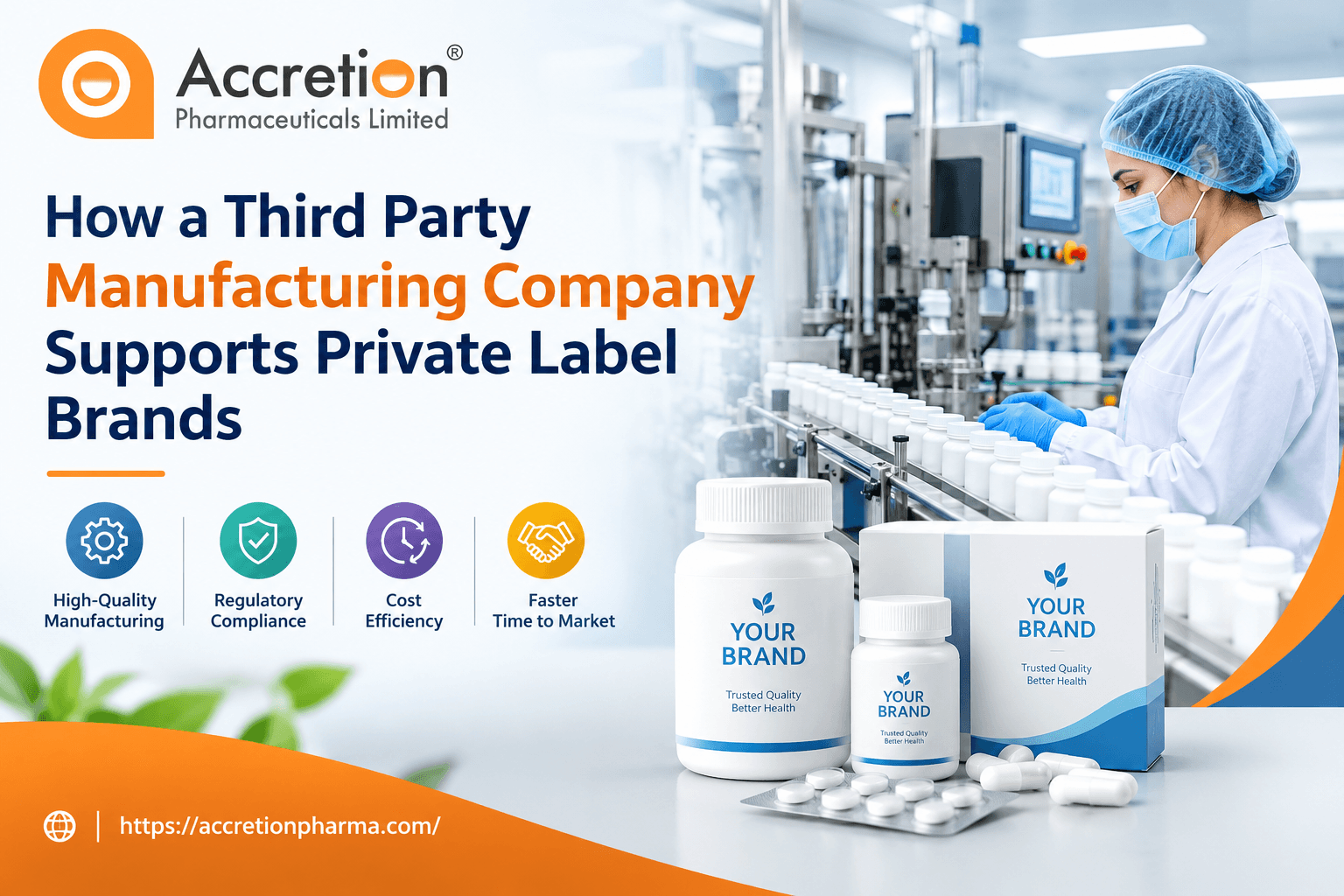
Launching a private label brand can be challenging when a business does not own a manufacturing facility. A third party manufacturing company allows brand owners to outsource production while focusing on product selection, branding, marketing, sales, and distribution. This model can reduce infrastructure requirements and provide access to established manufacturing capabilities, quality systems, and production expertise.
A third party manufacturing company supports private label brands by producing products according to an agreed formulation, specification, packaging, and quality requirements. The brand owner manages branding and market development, while the manufacturer handles production, testing, documentation, and manufacturing operations within applicable regulatory requirements.
What Is Private Label Manufacturing?
Private label manufacturing is a business arrangement in which one company markets a product under its own brand while another company manufactures it.
For example, a pharmaceutical business may develop a brand concept for a particular formulation but may not have its own production plant. Instead, it can partner with an established manufacturer that has suitable facilities, equipment, personnel, quality systems, and regulatory approvals.
The private label company can then concentrate on:
- Brand development and positioning
- Product portfolio planning
- Packaging and marketing
- Sales and distribution
- Customer relationships
The manufacturing partner focuses on converting the agreed product specification into a finished product.
This separation allows businesses to build a product portfolio without immediately investing in a complete manufacturing infrastructure.
How Does a Third Party Manufacturing Company Support Private Label Brands?
The relationship usually begins with product requirements and commercial discussions. Both parties should establish responsibilities before production starts.
A typical process includes:
- Product selection: The brand owner identifies the formulation, dosage form, specifications, and intended market.
- Manufacturer evaluation: Production capabilities, quality systems, certifications, capacity, and relevant licenses are reviewed.
- Commercial agreement: Pricing, minimum order quantities, payment terms, lead times, packaging, and responsibilities are documented.
- Production: The manufacturer produces the agreed product according to approved specifications.
- Quality testing: Applicable testing and quality-control procedures are completed before release.
- Packaging and dispatch: Products are packed according to agreed specifications and supplied to the brand owner or designated distributor.
The exact regulatory pathway depends on the product category and intended market.
Why Is Third Party Manufacturing Useful for Private Label Brands?
The major advantage is that private label businesses can access manufacturing capabilities without building a facility from the ground up.
Setting up a compliant manufacturing operation can require substantial expenditure on premises, machinery, utilities, quality-control laboratories, trained personnel, validation, maintenance, and regulatory compliance.
Outsourcing can instead allow a company to allocate more resources toward commercial activities.
For an emerging brand, this can be particularly useful when demand is uncertain. Rather than making a large fixed investment before proving the market, the company can work with an established production partner and scale its requirements as sales develop.
Third Party Manufacturing can therefore function as a flexible operational model, although its suitability depends on product type, volumes, regulatory requirements, and the manufacturer’s capabilities.
What Should Private Label Brands Check Before Choosing a Manufacturer?
Selecting a production partner should involve more than comparing quotations.
A practical evaluation should consider:
- Manufacturing licenses and applicable regulatory approvals
- Relevant product and dosage-form experience
- Quality-control and quality-assurance systems
- Manufacturing capacity and production scheduling
- Testing capabilities and documentation
- Packaging and labelling capabilities
- Batch traceability and complaint-handling procedures
- Minimum order quantities and lead times
- Contractual responsibilities and confidentiality
A low manufacturing price may not represent the lowest overall business cost if it is accompanied by inconsistent quality, delays, high rejection rates, or inadequate documentation.
What Regulatory Considerations Matter in India?
For pharmaceutical products in India, regulatory compliance is a central part of the manufacturing relationship. The Drugs and Cosmetics Act, 1940 and Drugs Rules, 1945 provide the principal regulatory framework for drugs, while manufacturing oversight is primarily handled by State authorities and specified categories are also subject to Central regulatory functions.
The regulatory position can vary depending on whether the product is a conventional drug, new drug, biological product, medical device, cosmetic, or another regulated category.
Therefore, a private label company should verify the applicable requirements rather than assuming that one licensing model applies to every product.
CDSCO also maintains current regulatory notifications, making it important for businesses to check for amendments and new requirements before finalising a manufacturing arrangement.
How Can a Private Label Brand Evaluate a Manufacturer in Gujarat?
Businesses searching for a third party manufacturing company in Gujarat should evaluate both regulatory suitability and practical manufacturing capability.
Gujarat has an established pharmaceutical and industrial ecosystem, but geographical proximity alone should not determine the choice of supplier.
A useful assessment can include:
- Review the manufacturer’s relevant licenses and facility information.
- Confirm experience with the specific product category.
- Examine quality-control procedures and available documentation.
- Discuss batch sizes, production capacity, and delivery schedules.
- Clarify packaging, artwork, labelling, and product-release responsibilities.
- Review commercial terms before placing a significant order.
Where appropriate, businesses can also conduct an audit or arrange a technical discussion with the manufacturer’s quality team.
What Does the Cost Structure Usually Include?
The final cost of a private label product is rarely determined only by the manufacturing charge.
Expenses can involve raw materials, active ingredients, excipients, packaging materials, testing, artwork, printing, logistics, regulatory requirements, and applicable taxes.
A manufacturer may also have minimum batch quantities because production involves equipment setup, cleaning, material handling, quality checks, and documentation.
For this reason, businesses should compare total landed cost rather than simply comparing the quoted price per unit.
A useful commercial review should examine:
- Product cost
- Packaging cost
- Testing or documentation charges
- Transportation
- Taxes and other applicable charges
- Minimum order requirements
- Payment terms
- Replacement or rejection policies
This approach provides a clearer picture of the actual economics of the private label model.
What Are Common Mistakes Private Label Brands Should Avoid?
Many problems arise because businesses select manufacturing partners primarily on price.
Other mistakes include failing to define product specifications, overlooking documentation requirements, ordering quantities that exceed realistic demand, and not establishing quality responsibilities in writing.
Another important issue is communication. Changes to formulation, packaging materials, artwork, specifications, or production schedules should be documented and approved through an agreed process.
A written quality or manufacturing agreement can help clarify responsibilities and reduce disputes.
Comparison: In-House vs Private Label Manufacturing
| Factor | In-House Manufacturing | Private Label Manufacturing |
| Initial infrastructure | High | Generally lower |
| Facility ownership | Brand-owned | Manufacturing partner |
| Operational control | High | Shared/contractual |
| Manufacturing expertise | Must be developed internally | Accessed through partner |
| Scalability | Requires internal expansion | Can be more flexible |
| Fixed investment | Usually substantial | Generally lower |
| Brand control | Direct | Defined through specifications and agreements |
Neither model is universally better. A mature business with substantial and predictable demand may eventually benefit from internal production, while a growing brand may find outsourcing more practical.
What Due Diligence Should a Brand Complete?
Before signing a long-term agreement, private label businesses should create a structured due-diligence checklist.
Check the manufacturer’s legal identity, relevant licenses, product experience, quality systems, manufacturing capacity, testing arrangements, documentation practices, and reputation.
It is also useful to request representative product information and understand how the manufacturer handles deviations, complaints, recalls, rejected batches, and changes to approved specifications.
For regulated products, responsibilities should be clearly established between the manufacturer and marketing company. CDSCO states that manufacture, sale, and distribution of drugs in India are regulated under the applicable legal framework, while Central and State authorities have different regulatory responsibilities.
Key Takeaways
- Private label manufacturing allows brands to outsource production while concentrating on commercial growth.
- The right manufacturing partner should be evaluated for quality, compliance, capacity, documentation, and reliability.
- Manufacturing cost should be assessed together with packaging, testing, logistics, taxes, and minimum order requirements.
- Written agreements should clearly define product specifications and responsibilities.
- Regulatory requirements depend on the product category and applicable Indian laws.
- Long-term partnerships should be based on consistent quality and transparent communication rather than price alone.
Conclusion
A private label business does not necessarily need to own a manufacturing facility to develop and expand its product portfolio. A reliable third party manufacturing company can provide production expertise, infrastructure, quality systems, and operational support while the brand concentrates on market development.
The strongest partnerships are built around clear specifications, regulatory awareness, transparent costing, quality assurance, and dependable communication. Businesses researching Top Third Party Manufacturers in Ahmedabad should therefore evaluate technical and compliance capabilities alongside price.
For pharmaceutical and other regulated products, reviewing applicable requirements through official regulatory sources such as CDSCO is an important part of responsible supplier selection.
Faqs
What does a third party manufacturing company do?
A third party manufacturing company produces products for another business according to agreed specifications, formulations, packaging requirements, and quality standards. The brand owner generally manages branding, marketing, sales, and distribution, while the manufacturer manages production and associated manufacturing activities. The exact responsibilities should be established contractually and according to the applicable regulatory framework.
Is third party manufacturing suitable for new private label brands?
Yes, it can be suitable for new brands that want to enter a market without immediately establishing their own manufacturing facility. Outsourcing can provide access to existing production infrastructure and technical expertise. However, businesses should first assess minimum order quantities, product demand, working capital, regulatory requirements, quality systems, and the manufacturer’s ability to support future growth.
How should I choose a private label manufacturer?
Start by checking the manufacturer’s relevant licenses, product experience, quality systems, production capacity, testing capabilities, documentation, delivery record, and commercial terms. It is also important to understand how complaints, rejected batches, deviations, changes, and recalls are handled. A structured evaluation is generally more reliable than selecting a supplier solely because it offers the lowest quotation.
What documents should private label brands review?
Depending on the product, documentation may include applicable manufacturing licenses, product specifications, test reports, certificates, batch documentation, packaging information, quality agreements, and commercial contracts. Requirements differ by product category and regulatory status. Businesses should verify the documents relevant to their particular product rather than relying on a generic checklist.
Can private label manufacturing help a brand scale?
It can provide operational flexibility when the manufacturing partner has sufficient capacity and can maintain consistent quality as order volumes increase. Before scaling, a brand should discuss production capacity, minimum batches, procurement timelines, packaging availability, testing requirements, and delivery schedules. Growth should be based on realistic demand forecasts rather than assuming that manufacturing capacity will always be immediately available.