
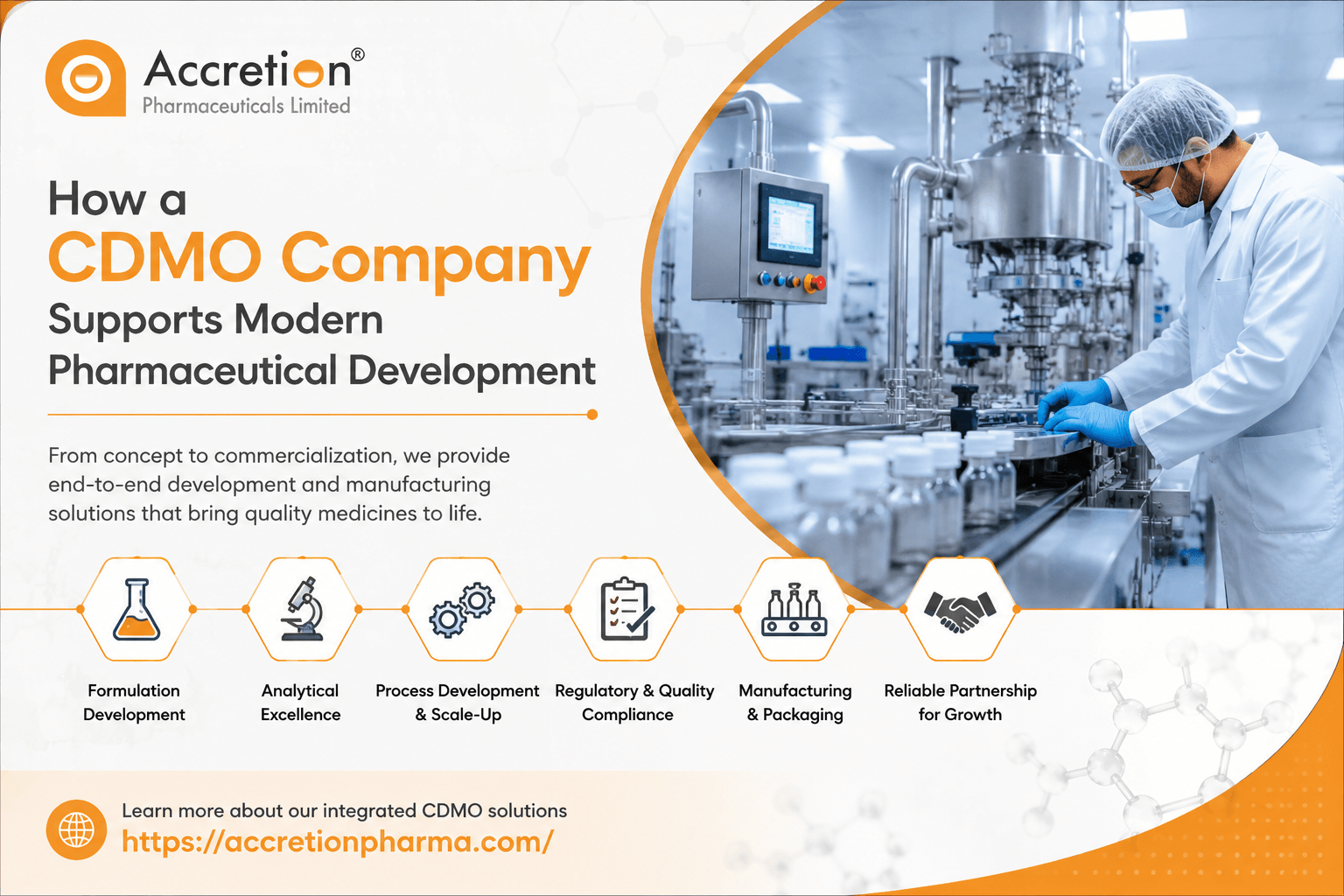
Modern pharmaceutical development requires more than discovering an active ingredient. It involves formulation research, analytical testing, process design, regulatory documentation, scale-up, and consistent manufacturing. This is where a CDMO Company can provide specialized capabilities that connect development activities with commercial production. By combining technical expertise, laboratory resources, manufacturing infrastructure, and quality systems, these organizations help drug developers move promising formulations toward reliable market-ready products while managing timelines, technical challenges, and operational complexity.
From Formulation Research to Commercial Manufacturing
Pharmaceutical development is a multi-stage process in which decisions made during early research can influence product quality, manufacturing efficiency, stability, and regulatory acceptance. External development partners can support several stages without requiring a pharmaceutical business to build every capability internally.
One important contribution is formulation development. Scientists evaluate ingredients, dosage forms, excipients, compatibility, dissolution characteristics, stability, and other parameters to create a formulation that meets defined performance requirements. Depending on the product, development may involve tablets, capsules, oral liquids, topical preparations, injectables, or other dosage forms.
Analytical development is another important area. Suitable analytical methods help determine identity, purity, potency, impurities, dissolution, and stability. Reliable analytical procedures are essential because they generate evidence used throughout development and quality assessment.
Process development then focuses on converting laboratory-scale procedures into reproducible manufacturing operations. A formulation that performs well in a laboratory may require adjustments when production volumes increase. Equipment characteristics, mixing conditions, material flow, temperature control, drying, compression, filling, and packaging can all affect the final product.
A structured development partner can also support technology transfer. This involves moving technical knowledge, specifications, manufacturing instructions, analytical procedures, and process parameters between development and production teams. Effective transfer reduces uncertainty and helps establish repeatable manufacturing practices.
Key areas of support include:
- Formulation and dosage-form development
- Analytical method development and validation support
- Stability studies and documentation
- Pilot and scale-up activities
- Process optimization and technology transfer
- Quality assurance and regulatory documentation
- Commercial manufacturing and packaging
Quality management remains central throughout these activities. Good Manufacturing Practice principles, documented procedures, controlled processes, equipment qualification, testing, and traceability help maintain consistent product standards. A mature quality system also creates documentation that can support regulatory submissions and inspections.
Another advantage is flexibility. Pharmaceutical businesses may require different levels of assistance depending on their development stage. An early-stage developer may need formulation and analytical expertise, while an established manufacturer might require additional production capacity or specialized technology. This adaptable model can reduce the need for major capital investments in facilities and equipment.
The growing interest in Private Labelling in India also demonstrates how external manufacturing capabilities can support businesses that want to develop products under their own brands. In such arrangements, technical specifications, quality requirements, packaging, regulatory responsibilities, and production controls need to be clearly defined. Careful coordination is essential to ensure that the finished product meets applicable standards.
When evaluating cdmo companies in india, pharmaceutical businesses should look beyond manufacturing capacity. Technical capabilities, quality systems, regulatory experience, dosage-form expertise, facility standards, analytical infrastructure, scalability, documentation practices, and communication processes are equally important.
| Development Area | Typical Support | Primary Benefit |
| Formulation | Dosage-form design and optimization | Improved product performance |
| Analytical | Method development and testing | Reliable quality assessment |
| Stability | Long-term and accelerated studies | Understanding product shelf life |
| Scale-Up | Process adjustment and optimization | Consistent larger-scale production |
| Technology Transfer | Technical documentation and process knowledge | Smoother production transition |
| Packaging | Pack development and production support | Product protection and presentation |
Regulatory support is another significant component of modern development. Pharmaceutical products require extensive technical documentation covering formulation, manufacturing processes, specifications, analytical procedures, stability data, and quality controls. Experienced technical teams can help organize these materials and maintain consistency between development information and manufacturing practices.
Supply-chain coordination can also influence development success. Raw material availability, approved suppliers, packaging components, batch planning, inventory management, and production scheduling need consideration before commercial launch. Early attention to these factors can prevent avoidable delays during scale-up.
Technology is increasingly influencing pharmaceutical development as well. Modern laboratories use advanced analytical instruments, process monitoring tools, electronic documentation, and data-management systems to improve traceability and decision-making. Digital systems can also make it easier to review development information and identify deviations or process trends.
For pharmaceutical businesses, selecting an appropriate development and manufacturing partner should therefore be based on product requirements rather than reputation alone. A suitable evaluation can include facility capabilities, quality certifications, technical staff, regulatory knowledge, previous dosage-form experience, production capacity, communication standards, and the ability to scale with future requirements.
Ultimately, external development support can help create a more connected pathway from laboratory research to manufacturing. The strongest partnerships are built around clearly defined responsibilities, transparent technical communication, quality-focused processes, and realistic development milestones. Rather than treating manufacturing as a separate final step, an integrated approach considers formulation, testing, scale-up, compliance, and production from the beginning. Businesses researching top cdmo listed companies in india should similarly assess technical depth, quality infrastructure, regulatory readiness, scalability, and suitability for their specific pharmaceutical development requirements.
Faqs
What is a CDMO Company in pharmaceutical development?
A CDMO Company provides specialized services such as formulation development, analytical testing, process development, scale-up, manufacturing, packaging, and regulatory support for pharmaceutical products.
How does a CDMO support drug formulation development?
A development partner helps design and optimize formulations by evaluating active ingredients, excipients, dosage forms, stability, dissolution, compatibility, and other quality parameters.
What services are commonly offered by pharmaceutical development partners?
Services may include formulation development, analytical method development, stability studies, pilot batches, process optimization, technology transfer, commercial manufacturing, packaging, and documentation support.
How does a CDMO help with pharmaceutical scale-up?
It converts laboratory-scale processes into larger manufacturing operations by optimizing equipment, process parameters, material handling, production conditions, and quality controls.