
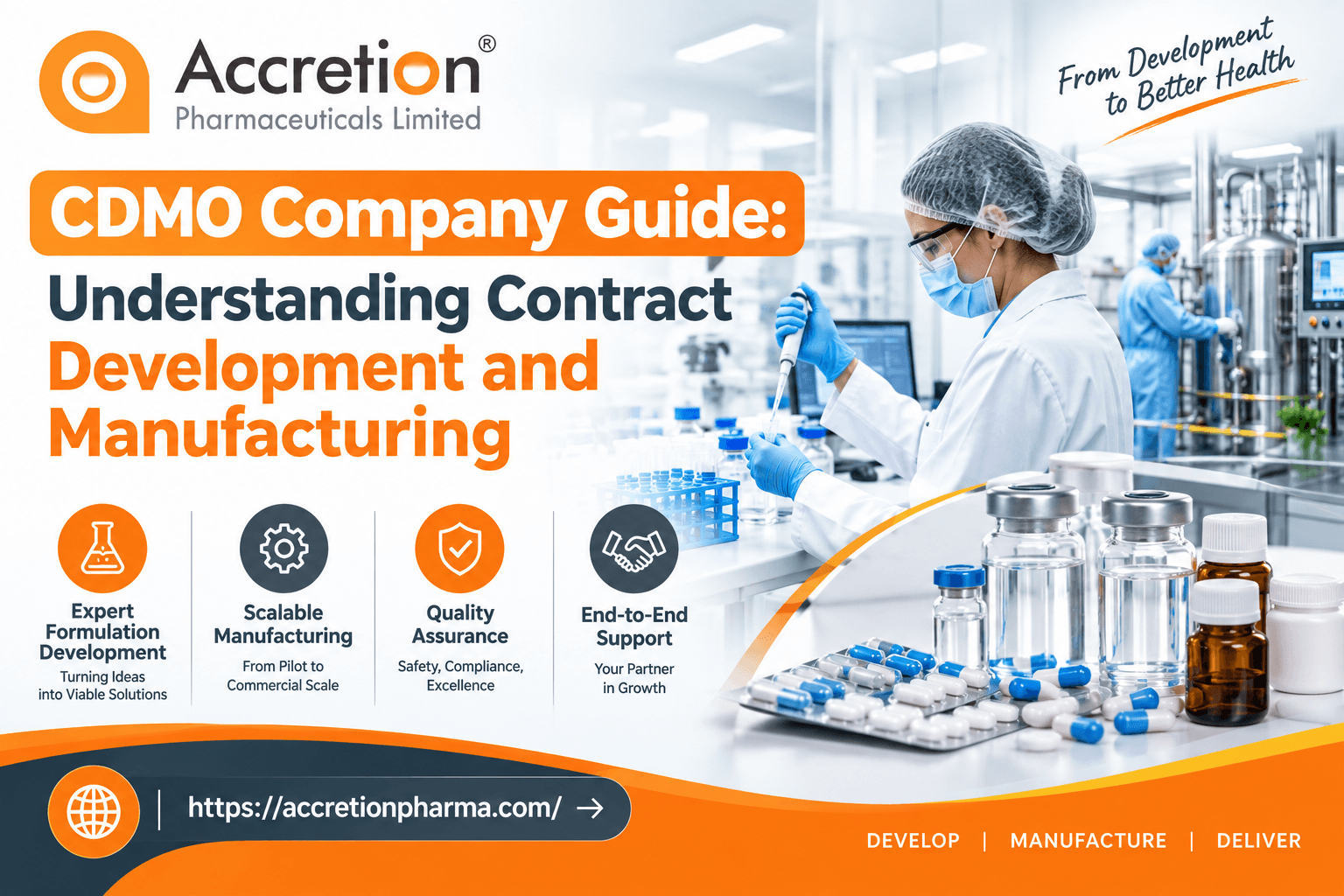
The pharmaceutical industry increasingly relies on specialized partners to develop, test, manufacture, and scale medicines efficiently. Instead of investing in every development capability and manufacturing facility internally, pharmaceutical and biotechnology businesses can work with specialized organizations that provide technical, regulatory, analytical, and production support.
A CDMO Company combines contract development and manufacturing capabilities under one partnership. Depending on the project, it may support formulation development, analytical testing, process optimization, clinical-trial material, commercial production, packaging, and regulatory documentation.
Understanding how these partnerships work is important for pharmaceutical companies, startups, biotechnology firms, and product owners evaluating outsourcing options. This guide explains the CDMO model, services involved, selection criteria, regulatory considerations, costs, risks, and practical due diligence steps.
What Is a CDMO Company?
A CDMO company is a pharmaceutical partner that provides contract development and manufacturing services to another business. Its support can range from formulation and process development to analytical testing, scale-up, regulatory assistance, and commercial manufacturing. The model allows companies to access specialized expertise and production infrastructure without building every capability internally.
What Does a CDMO Company Do?
A contract development and manufacturing organization can participate at different stages of the pharmaceutical product lifecycle.
Some providers focus mainly on development, while others offer integrated capabilities extending through commercial manufacturing. The appropriate model depends on the product, dosage form, development stage, market, and regulatory requirements.
Typical activities include:
- Formulation and process development
- Analytical method development and validation
- Stability studies
- Pilot and scale-up activities
- Clinical-trial material manufacturing
- Commercial manufacturing
- Packaging and serialization support
- Technology transfer
- Quality and regulatory documentation
For example, a biotechnology startup developing a new formulation may lack specialized production equipment. It can work with an external partner to optimize the process, manufacture development batches, and prepare for larger-scale production.
What Are CDMO Services?
CDMO Services cover more than simply manufacturing pharmaceutical products. They can connect scientific development with reproducible commercial production.
Development Support
Development teams may help optimize formulation composition, manufacturing processes, dosage forms, and critical process parameters.
Analytical Support
Analytical laboratories can perform testing related to identity, purity, potency, impurities, dissolution, stability, and other product-specific requirements.
Manufacturing Support
Manufacturing capabilities may include oral solid dosage forms, liquids, topical products, injectables, biologics, or other specialized categories, depending on the facility.
Scale-Up and Technology Transfer
Moving from laboratory-scale development to commercial production requires controlled technology transfer. Equipment differences, process parameters, raw-material characteristics, and batch-size changes must be evaluated carefully.
How Does the CDMO Process Work?
A typical outsourcing relationship follows a structured sequence.
1. Define the Product Requirements
The sponsor establishes the product, dosage form, target market, development stage, expected volumes, quality requirements, and regulatory pathway.
2. Evaluate Technical Capability
The prospective partner is assessed for equipment, facilities, personnel, analytical capability, quality systems, and experience with the relevant product category.
3. Establish Quality and Commercial Terms
The parties typically define responsibilities through agreements covering quality, confidentiality, intellectual property, specifications, testing, documentation, supply, and commercial conditions.
4. Transfer and Validate the Process
Development information and manufacturing knowledge are transferred under controlled procedures. Process performance and analytical methods may require qualification or validation depending on the stage and applicable requirements.
5. Manufacture and Monitor
Production is performed according to approved procedures and applicable quality requirements. Batch records, testing, deviations, investigations, and release documentation form part of the quality framework.
Why Do Companies Use Contract Development and Manufacturing?
Outsourcing can be useful when a business needs capabilities that would be expensive or time-consuming to establish internally.
A company may choose this model to access specialized equipment, technical expertise, quality systems, manufacturing capacity, or development experience.
The decision should not be based solely on manufacturing price. A lower quotation may become expensive if it leads to delays, failed batches, inadequate documentation, or repeated technology-transfer problems.
What Should You Check Before Choosing a CDMO?
Selecting a partner requires technical, regulatory, commercial, and operational evaluation.
Facility and Technical Capability
Confirm that the facility can handle the specific dosage form, batch size, equipment requirements, containment needs, and development stage.
Quality Systems
Review the organization’s quality management system, deviation handling, CAPA procedures, change control, document control, training systems, and batch-release processes.
Regulatory Readiness
For Indian pharmaceutical projects, regulatory responsibilities may involve the Central Drugs Standard Control Organization (CDSCO), state drug-control authorities, the Drugs and Cosmetics framework, and applicable product-specific requirements.
India’s New Drugs and Clinical Trials Rules, 2019 govern important aspects of new-drug approvals and clinical trials. CDSCO also maintains regulatory information and application processes for new drugs and investigational products.
The regulatory position should therefore be evaluated according to the product and intended market rather than assumed from the supplier’s general certifications.
Capacity and Supply Reliability
Ask whether the partner has sufficient capacity for development batches as well as future commercial requirements. Production scheduling, raw-material sourcing, equipment availability, and contingency planning can directly affect supply continuity.
How Important Is Regulatory Compliance?
Regulatory compliance is fundamental because pharmaceutical quality cannot be separated from manufacturing controls.
In India, Schedule M is an important part of the manufacturing framework, and CDSCO published the final Schedule M notification in December 2023. CDSCO also issued information concerning implementation of Schedule M and WHO Technical Report Series requirements in 2024.
For products intended for international markets, additional requirements may apply depending on the destination country’s regulator and the product category.
A responsible evaluation should therefore consider:
- Applicable manufacturing licences
- GMP compliance
- Product-specific approvals
- Quality agreements
- Data integrity controls
- Validation documentation
- Audit history and corrective actions
- Regulatory inspection readiness
CDMO Companies in India: What Should Buyers Evaluate?
Businesses researching cdmo companies in india should look beyond facility size or years in operation. A suitable partner needs to match the technical and regulatory requirements of the actual project.
Important evaluation areas include manufacturing capabilities, quality systems, analytical infrastructure, development expertise, scalability, documentation practices, and supply-chain reliability.
A practical comparison can look like this:
| Evaluation Factor | Basic Evaluation | Strong Evaluation |
| Technical capability | General manufacturing | Product-specific expertise |
| Quality system | Basic documentation | Mature QMS and controlled processes |
| Development | Limited support | Integrated development and scale-up |
| Capacity | Current requirements only | Current and future demand planning |
| Regulatory support | Documentation assistance | Structured regulatory coordination |
| Technology transfer | Informal or limited | Controlled and documented transfer |
The right choice depends on the product and business objective rather than a simple ranking of suppliers.
What Are the Main Costs Involved?
CDMO pricing can include development fees, analytical testing, pilot batches, manufacturing charges, packaging, regulatory support, stability studies, technology transfer, and other project-specific costs.
The final commercial structure may also depend on batch size, raw materials, formulation complexity, specialized equipment, testing requirements, and production frequency.
When comparing proposals, businesses should request a detailed cost breakdown instead of comparing only the quoted manufacturing price.
A useful approach is to calculate the total cost of ownership, including development, testing, documentation, logistics, minimum order quantities, rejected batches, storage, and potential rework.
What Risks Should Companies Watch For?
Outsourcing reduces the need for internal infrastructure, but it does not eliminate business risk.
Common risks include inadequate quality oversight, unclear responsibilities, poor communication, limited manufacturing capacity, unexpected process changes, supply-chain disruptions, and intellectual-property concerns.
Companies can reduce these risks by establishing clear contracts and quality agreements, defining ownership of development data, conducting appropriate audits, and maintaining documented change-control procedures.
Another important consideration is business continuity. A supplier should have reasonable contingency planning for critical raw materials, equipment failures, utilities, staffing, and other operational disruptions.
Expert Due Diligence Checklist
Before signing a long-term agreement, buyers should systematically review the prospective partner.
- Verify capabilities: Confirm equipment, dosage-form expertise, analytical facilities, capacity, and development resources.
- Review quality documentation: Examine licences, certifications, validation systems, deviations, CAPA processes, change control, and audit history.
- Clarify commercial terms: Define pricing, minimum order quantities, lead times, payment terms, ownership, confidentiality, termination conditions, and supply commitments.
A technical audit may be appropriate for higher-risk projects. The depth of due diligence should reflect the product’s regulatory classification, development stage, intended market, and commercial importance.
Best Practices for a Successful Partnership
A successful outsourcing relationship requires more than a signed manufacturing agreement.
Maintain a clearly documented technical package and define responsibilities from the beginning. Establish regular communication between development, quality, regulatory, procurement, and manufacturing teams.
It is also useful to agree on measurable project milestones. These can include formulation completion, analytical-method readiness, engineering batches, validation activities, regulatory submissions, and commercial batch release.
For complex products, involving quality and regulatory specialists early can prevent expensive changes later.
Key Takeaways
- A CDMO can support pharmaceutical development, testing, scale-up, and manufacturing.
- The right partner should match the product’s technical and regulatory requirements.
- Quality systems and regulatory compliance should be evaluated alongside price.
- Technology transfer must be controlled, documented, and technically sound.
- Contracts and quality agreements should clearly define responsibilities and ownership.
- Scalability and supply continuity matter when selecting a long-term manufacturing partner.
- Due diligence should include technical, regulatory, financial, and operational assessment.
Conclusion
Choosing a contract development and manufacturing partner is a strategic decision that can influence product quality, regulatory readiness, development timelines, manufacturing continuity, and overall commercial risk. A reliable CDMO Company should therefore be assessed on technical capability, quality systems, regulatory knowledge, scalability, communication, and long-term operational fit—not simply on price.
Businesses comparing the top cdmo listed companies in india should also distinguish between market visibility and suitability for a specific project. The most appropriate partner is the one whose capabilities, quality framework, regulatory readiness, capacity, and commercial model align with the product’s actual requirements.
Before entering a long-term relationship, conduct structured due diligence, document responsibilities clearly, and verify current regulatory requirements with the appropriate authorities. CDSCO remains an important reference point for Indian pharmaceutical regulatory information, particularly for new drugs, clinical trials, and applicable manufacturing requirements.
Faqs
What is the difference between a CDMO and a contract manufacturer?
A contract manufacturer primarily focuses on producing a product according to agreed specifications. A CDMO can provide broader support, including formulation development, process development, analytical work, scale-up, technology transfer, and manufacturing. However, the exact scope varies between providers, so companies should evaluate the actual capabilities included in a proposed engagement.
When should a pharmaceutical company consider a CDMO?
A pharmaceutical company may consider a CDMO when it needs specialized development expertise, manufacturing capacity, analytical infrastructure, or faster access to established production capabilities. It can be particularly useful for startups and businesses entering new dosage forms or markets where building an internal facility would require significant capital and technical resources.
How do I select the right CDMO partner?
Start by defining the product, development stage, target market, dosage form, expected volumes, and regulatory requirements. Then assess technical capabilities, quality systems, manufacturing capacity, analytical facilities, regulatory experience, communication practices, commercial terms, and business continuity. For higher-risk projects, a quality audit and detailed technical assessment can provide additional assurance.
Are CDMO companies in India suitable for international pharmaceutical markets?
Some Indian CDMO providers support products intended for international markets, but suitability must be assessed individually. Companies should verify the facility’s relevant regulatory experience, quality systems, manufacturing standards, inspection history, documentation capabilities, and ability to meet the requirements of the destination market. International compliance should never be assumed solely because manufacturing occurs in India.
What should a pharmaceutical company include in a CDMO agreement?
A comprehensive agreement should address product specifications, responsibilities, intellectual property, confidentiality, quality requirements, testing, deviations, change control, documentation, audits, batch release, supply terms, pricing, timelines, dispute resolution, and termination provisions. A separate quality agreement may be appropriate to define detailed quality responsibilities and communication procedures.